

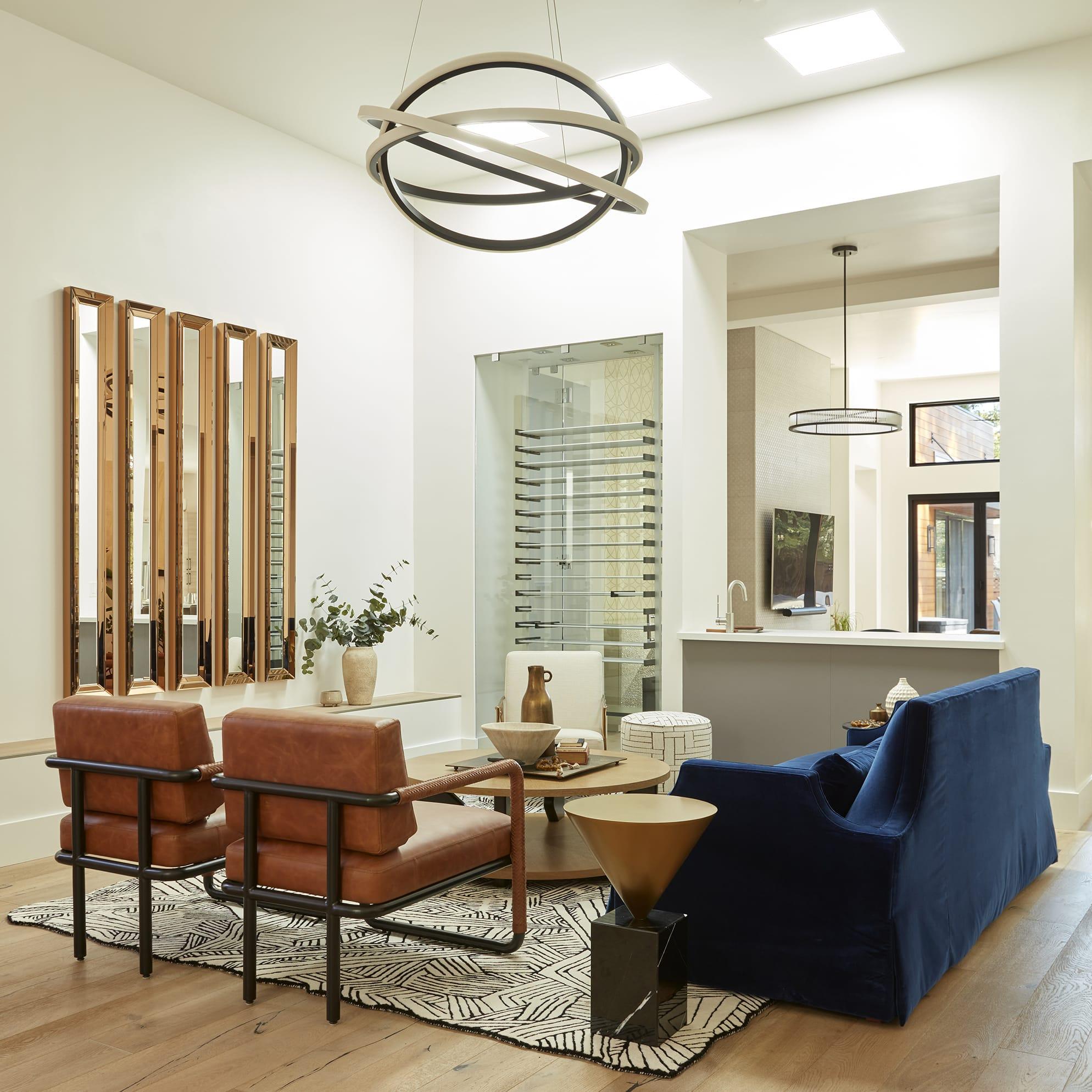
Search for advice on how to choose an interior designer and you will find the same list everywhere. Look for someone passionate. Look for a good listener. Look for a strong portfolio.
The same list appears under how to pick an interior designer, and under every variation of the question. All of it is true, and none of it helps.
The problem is that those are descriptions of a good designer, and you are not trying to describe one. You are trying to tell several apparently good ones apart. Every studio you contact will seem passionate, will listen well in a first meeting, and will have a portfolio of rooms that photograph beautifully. Those qualities do not separate anybody.
What you need are criteria that produce different answers from different studios. Scope fit. Evidence of work like yours. Who actually does the work. How the fee is built. What happens when something goes wrong.
Ask those and the field sorts itself quickly.
Build a shortlist of three or four studios whose finished work resembles your project in type and scale. Compare them on scope fit, who does the work day to day, fee structure, and how they handle problems. Check references and read the contract closely. Then choose on evidence and a working relationship together.
A criterion has to be capable of producing a no.
If every candidate passes a test, the test is not doing anything. Most published advice on this subject stops there. Passion, communication and creativity are real qualities, and they are also qualities that every studio will display in a meeting they want to win.
There is a second problem. These are qualities you can only assess after the fact. You find out how well a designer listens somewhere around the third revision, when you discover whether the thing you said in week one made it into the drawings. By then you have signed.
Useful criteria share three properties. They are answerable before you commit. Different studios answer them differently. And a weak answer is recognisable as weak, even to someone who has never run a project.
“How many projects do you run at once” is a criterion. “Are you passionate about design” is a conversation opener.
This also explains why so much advice on how to find an interior designer feels unsatisfying. The advice is written to be agreeable. Nobody wants to publish the list of things that might rule out a colleague, so the published version stays at the level of temperament, and the reader is left choosing on instinct and photographs.
Most people start with a search, and a search is a reasonable place to start as long as you know what it is giving you.
Referrals remain the strongest source, and the useful question is not whether your friend liked their designer. Ask what the project was. A studio that furnished a friend’s condo beautifully may never have coordinated a permit. Ask what the scope was, what went wrong, and whether they would use them again for something larger.
Local search is how most people begin, and searching for a home designer near me will show you who has invested in being visible, which correlates loosely with size and not at all with fit. Treat the first page as a starting list and nothing more.
Portfolio directories such as Houzz collect finished work at scale and are genuinely useful for one narrow purpose, which is finding studios whose work resembles what you want. Filter by project type and location, then look at how many projects each studio has published and over what period. A studio with four projects from six years ago is a different proposition from one with thirty across the last three.
Instagram shows you taste and almost nothing else. It shows you a studio’s eye more clearly than any other source, and tells you nothing about whether they can run a build.
Trade sources are worth one question. Contractors, architects and cabinet makers work alongside designers constantly and see which ones cause problems. If you already have a contractor you trust, ask who they like working with, and ask why.
Cast wider than you think you need to, then cut hard. Five studios contacted and three shortlisted is a healthier process than two contacted and one chosen by default.
One thing is worth knowing before the criteria, because it changes what is worth checking.
California does not license interior designers. There is no state register to look someone up in, the way there is for architects or contractors. Anyone here may describe themselves as an interior designer, and doing so breaks no rule.
What California does have is a protected title. “Certified Interior Designer” is administered by a state-overseen body, and using those specific words without qualifying for them is an unfair business practice. It is a narrow protection, covering the title alone.
Two things follow, and they point in different directions from what you might expect.
The absence of a certification is not a warning sign. It is voluntary in California, assessed through a state-specific exam, where other jurisdictions use a national one used in other jurisdictions, and a great deal of accomplished residential work is done by designers who have never sought it. Treating it as a threshold would rule out much of the field, including many of the studios whose work you already admire.
The more useful consequence is the second one. With no license to look up, the whole burden moves onto evidence. You cannot verify a designer through a register. You verify them by looking hard at what they have built, speaking to the people they built it for, and reading what they are willing to put in writing.
Which is what the rest of this comes down to.

These are the comparisons that produce different answers. Run the same five past every studio on your shortlist and the differences appear quickly.
| What to compare | A weak answer | A strong answer |
|---|---|---|
| Scope fit | “We do everything” | “We mostly do whole-home furnishing. A single room is not our best use.” |
| Comparable work | A portfolio of rooms that photograph well | Three projects of your type and scale, with the constraint in each one named |
| Who does the work | “Our team” | A named person who stays with you, and what happens if they leave |
| Fee structure | “It depends on the project” | A model named up front, and what triggers an additional charge |
| When something goes wrong | Silence, or “that does not happen” | A described process, and a recent example |
Scope fit is the one people skip and the one that causes the most trouble. A studio that furnishes beautifully and a studio that runs construction are different businesses, and plenty do both without doing both equally. A designer willing to tell you that your project is not their strongest work is giving you information, not losing your business.
Comparable work means comparable in type and scale, not in style. A gorgeous kitchen tells you little about whether a studio can handle a whole house. Ask to see three projects like yours, and listen for whether they describe the problem each one presented or only the finished result.
Who does the work matters more in year two than in week one. Ask who leads the design, who you speak to weekly, and who is on site. Then ask what happens if that person leaves.
Fee structure is where clarity predicts everything else. The model itself matters less than whether they can explain it without hedging, and whether they will tell you what is excluded. A studio that answers this crisply usually runs the rest of the project the same way.
When something goes wrong is the question almost nobody asks and the one that reveals most. Furniture arrives damaged, a finish is discontinued, a wall opens up to a surprise. It happens on every project. A studio with a real answer has been through it. A studio that reaches for reassurance has either been lucky or is not telling you.
The clients who choose well are the ones who ask me something I have to think about. Anyone can answer whether they are passionate about design. Fewer people enjoy being asked what happens when a sofa arrives in the wrong fabric eight weeks before a family arrives for the holidays. I would rather be asked. It tells me they are taking the project as seriously as I will, and it means we start out honest about the fact that projects contain problems.
Kanika Bakshi Khurana
By this point you should have three studios and a set of comparable answers. The last part is a process, and it has steps.
Interview properly. Meet in the space if you can, because a designer walking your actual rooms will say things a meeting cannot produce. There is a full set of questions worth asking in the first conversation, and we have written them up separately, so use that as your checklist and this article as the way you got to a shortlist.
Take references, and ask the awkward question. Speak to two past clients, ideally one recent and one from three or more years ago. The recent one tells you how the studio works now. The older one tells you how the work has aged and whether anyone answered the phone six months after handover. Ask both what they would do differently.
Read the contract slowly. Look for what is included, how many revisions you get, what happens to the fee if the scope changes, who owns the drawings, and how either side can stop. A contract that is vague at the start will be vague at the point you need it.
Then weigh the relationship. Everything above is evidence, and evidence does not settle it on its own. You will be working with this person for months, through decisions that cost money and occasionally through bad news. Choose someone you would want to hear bad news from. This is not a soft criterion. It is the one that determines whether the project stays honest when it gets difficult.
We are an interior design studio on the Peninsula, working with homeowners across Palo Alto, Los Altos, Menlo Park, Redwood City and the wider Bay Area.
If you are shortlisting a Bay Area interior designer and we are on the list, we would expect the five comparisons above and would rather you ran them on everyone. We take a deliberately limited number of projects, you work with Kanika directly on the design, and we would tell you plainly if your project is not the kind we do best.
This suits full-service furnishing and remodeling work where one studio carries the project from design through installation. If you want a single room styled or an hour of advice, a smaller engagement elsewhere will serve you better and cost you less. If you are shortlisting for something larger, start with a consultation and put us through the same five questions as everyone else.
Fee models vary, commonly a flat design fee, an hourly rate, a percentage of the project, or a combination, with furnishings and construction billed separately. The number matters less than the clarity. We have written separately about the fee conversation and what a clear answer sounds like, and that is the piece to read before your first meeting.
Three is the practical number. One gives you nothing to compare against, and beyond four the conversations blur together and the process stalls. Contact five, expect one or two to be unavailable or wrong for the scope, and interview the rest properly.
Broadly, a decorator works with furnishings and surfaces, while a designer works with space, layout, light and how a home functions, and can lead a renovation. A project that changes how rooms are used or built needs a designer. Working out how to choose an interior decorator is a different exercise from choosing a designer, and it is worth settling which one you actually need first.
No. California has no license or registration requirement for interior designers, only a protected title for those who have completed a specific state certification. Many accomplished residential designers are not certified. Because there is no register to check, evidence of comparable work and references carry the weight instead.
Two to four weeks is reasonable for shortlisting, interviewing and checking references, and it is time well spent against a project that will run for months. Rushing this stage is the most common cause of a mismatch, and a mismatch is far more expensive to fix later than a fortnight of diligence is now.
RECENT COMMENTS