

Kitchen backsplash ideas should begin with the role the surface needs to play. A backsplash protects the wall, but it also sits between some of the kitchen’s largest finishes. Material, maintenance and visual weight should be considered with the countertop and cabinetry before the backsplash becomes a focal point.
The strongest kitchen backsplash ideas do more than fill the wall between a countertop and upper cabinets. The backsplash has a practical job near cooking and cleaning areas, while its position puts it beside cabinetry, counters, hardware and lighting.
Some kitchens benefit from a quiet surface. Others have enough visual restraint elsewhere to support stronger color, pattern or stone.
Homeowners do not need to begin by choosing subway tile, marble or mosaic. First decide what job the backsplash needs to do in the room.
A backsplash protects the wall from water, grease and food spatter around sinks and cooking areas. Ceramic tile is widely used for this purpose because it creates a durable surface that is straightforward to clean. The Tile Council of North America also notes that ceramic tile itself tends to clean easily, while grout requires more care.
The design question begins once that practical requirement is met.
Before selecting the material, check four things:
| Question | Why it matters |
| What already carries the strongest pattern? | It determines how much visual activity the backsplash needs |
| How much backsplash will remain visible? | Open wall area gives the material greater presence |
| Where are the main sightlines? | A range wall may be visible from adjoining rooms |
| How is the kitchen used? | Cleaning and maintenance tolerance affect material choice |
A backsplash works better as part of the kitchen plan than as a decorative decision made at the end.
A backsplash can lead the room when the surrounding surfaces leave room for it.
Restrained cabinetry and a quieter counter can support a bold backsplash with color, pattern or natural stone. A strongly figured countertop changes the calculation because the counter already carries movement across a large surface.
The amount of visible wall matters too. A backsplash confined beneath upper cabinets has less visual presence than a tall range wall or an open wall with little cabinetry.
A statement backsplash works when its scale suits the wall and the rest of the kitchen supports it.
“The backsplash is often treated as a practical finishing detail, but I see it as an opportunity to create a natural piece of artwork in the kitchen. When space allows, replacing some upper cabinetry with a beautiful slab of natural stone or a distinctive backsplash tile can make the room feel more open and visually striking. The result is a kitchen that feels thoughtfully designed rather than simply filled with storage.”
Kanika Bakshi Khurana
Tile and slab create different kinds of surfaces.
Tile introduces repetition through shape, layout and grout. The same ceramic tile can look substantially different in a vertical stack, running bond or herringbone pattern.
Slab stone reads as a larger continuous field. Natural veining becomes the pattern, with fewer joints interrupting the material.
| Condition | Direction worth considering |
| Countertop has strong movement | Quieter tile or a restrained continuation of the same material |
| Countertop is visually quiet | Patterned tile or expressive stone has more room |
| Kitchen has many upper cabinets | Smaller-scale tile can suit the reduced visible area |
| Range wall is open and prominent | Slab stone or a larger composition can use the available scale |
| Household wants simpler routine cleaning | Fewer joints may be preferable |
| Natural material is central to the room | Review the actual slab or tile variation |
These are planning cues, not fixed rules. The right choice still depends on the specific kitchen.
Grout changes both the appearance and upkeep of tile.
A close grout color allows the surface to read more continuously. Greater contrast emphasizes the tile shape and layout.
Cementitious grout is porous and can absorb stains. The Tile Council of North America notes that sealing is commonly used to improve resistance, while epoxy grout behaves differently.
Mosaic tile creates far more joint area than large-format tile, so grout becomes more prominent both visually and practically.
The grout sample should be reviewed beside the tile before installation.
Natural stone needs to be assessed as a material, not just as a pattern.
Marble, granite, quartzite and other stones behave differently. The Natural Stone Institute notes that calcareous stones such as marble are sensitive to acidic solutions and recommends cleaning products appropriate to the specific stone.
It also cautions that sealing improves stain resistance without making stone stain-proof, and that some stones may not require sealing.
For slab stone, the actual piece matters when veining is central to the design. Seam position and vein direction should be resolved before fabrication.
The countertop and backsplash should be reviewed side by side because they meet directly.
If one surface has strong movement, the other usually needs enough restraint to keep the composition legible. That does not mean the two materials have to match.
A quiet counter can support handmade tile, geometric forms, saturated color or expressive stone. A highly figured counter may work better with a simpler wall treatment or a continuation of the same material.
This is also where kitchen backsplash patterns need enough uninterrupted wall to read properly. A complex pattern can lose its effect when broken into narrow strips around outlets, cabinets and trim.
Yes. The amount of color often matters as much as the hue itself.
A saturated backsplash beneath a full run of upper cabinets occupies less visual area than the same material carried to the ceiling. A colorful feature behind the range can remain concentrated while quieter material continues elsewhere.
Kanika Design’s Daly City kitchen offers one example. Navy lower cabinets provide the dominant color, while the backsplash combines stainless steel, marble and glass in a hexagonal pattern. White upper cabinets and quartz counters give those stronger elements enough visual space.
The useful lesson is in the distribution. The backsplash does not need to carry every idea in the kitchen.
No. A trend can introduce a useful material or layout, but it still has to suit the room.
Current search results heavily feature stacked subway tile, herringbone layouts, handmade-look tile, geometric mosaics and full-height stone slabs. The supplied SERP research shows how strongly this category is driven by visual lists and current treatments.
For a long-term kitchen, the better questions are practical:
Those questions are more useful than following one of the latest modern kitchen backsplash ideas simply because it is current.
A backsplash designed as part of the whole kitchen (designer kitchen backsplash) responds to the actual wall.
That can mean centering a pattern behind the range, aligning joints with cabinetry, choosing a slab for the direction of its movement or planning the hood and open shelves around the material.
The wall should be measured with outlets, windows, cabinet edges, hood dimensions and other interruptions shown before the layout is finalized.
The Tile Council of North America advises planning tile layouts to avoid awkward small cuts and using installation products suited to the tile, substrate and location.
Material quality cannot compensate for an unresolved layout.
A quieter backsplash makes sense when the kitchen already has several strong elements.
Cabinet color, natural stone counters, wood grain, patterned flooring or statement lighting may already provide enough visual activity. In that case, a simple ceramic tile, restrained texture or a material close in tone to the countertop can connect the room without adding another competing feature.
This matters even more in an open-plan home, where the kitchen sits within a larger view that includes dining and living areas.
A backsplash can be an appropriate standalone change when the rest of the kitchen already works.
If the cabinetry is sound, the countertop is staying and the layout functions well, replacing an outdated or damaged surface may be enough.
The existing conditions still need checking. Removing tile can affect the wall behind it, and a different material thickness can change how outlets, trim and countertop transitions are handled.
A broader kitchen design becomes useful when the backsplash depends on new cabinets, counters, lighting, a hood, open shelving or altered walls.
Read Also – Kitchen Layouts Designers Use to Maximize Space and Luxury
Kanika Design considers backsplash material with the finishes that will remain beside it.
In a full kitchen project, layout and cabinetry establish the room first. Countertops, backsplash, hardware and lighting are then reviewed together because each affects how the others read.
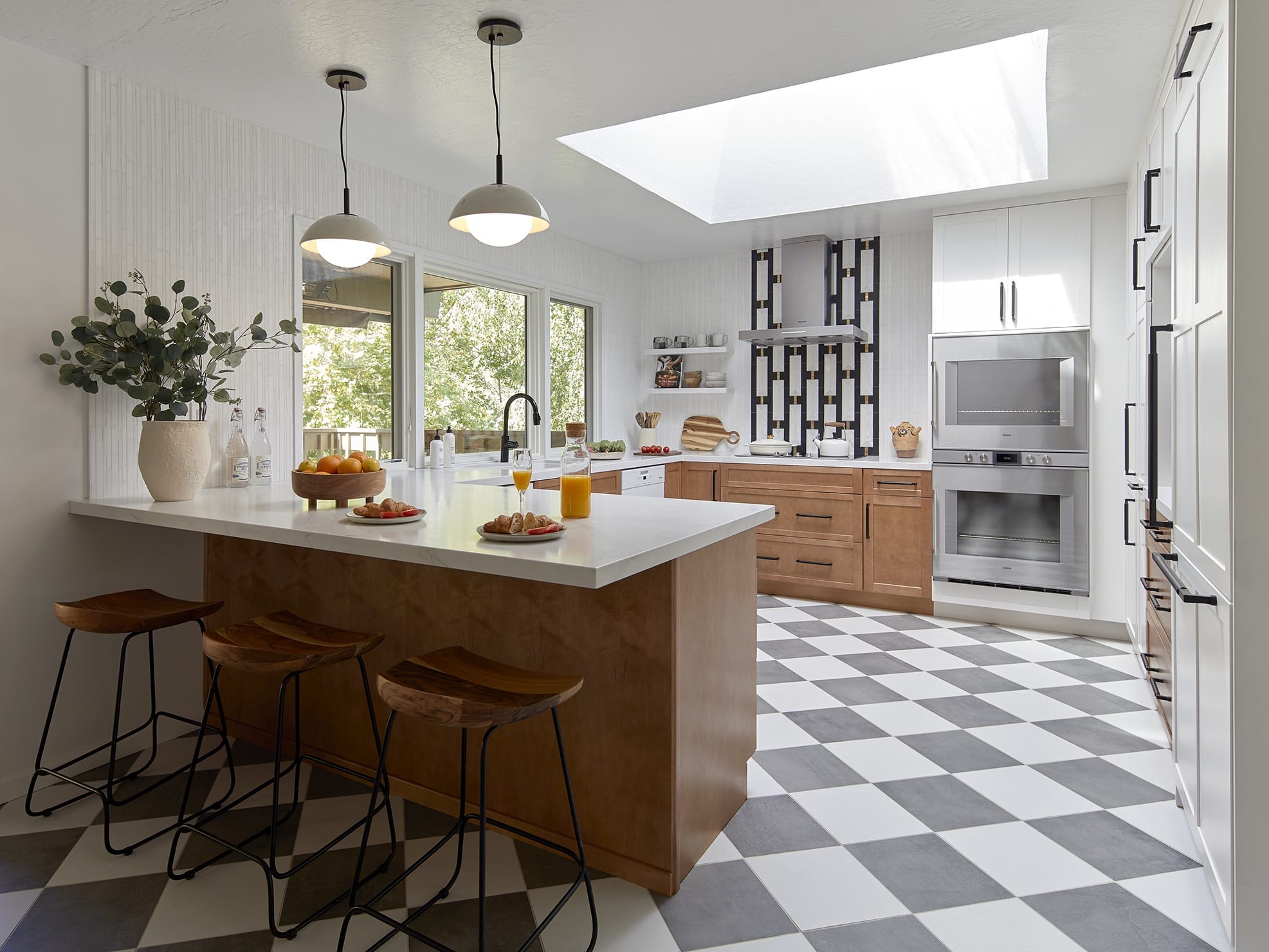
The Los Altos Hills renovation shows how that coordination can work. The kitchen used a black, white and gold Italian-made backsplash within a wider scheme of checkerboard flooring, neutral cabinetry and oak built-ins.
Kanika Design’s full-service process covers material and finish selection along with the wider design, procurement and installation work. Homeowners researching interior design San Jose can see the studio’s current San Jose service scope.
This level of design service suits a kitchen or broader home project where the backsplash is tied to several other decisions. A homeowner replacing tile on an otherwise resolved wall can work directly with a tile showroom and installer.
Large surfaces with fewer joints reduce the amount of grout that needs routine cleaning. Glazed ceramic tile itself is generally easy to clean, although cementitious grout is porous and requires more attention.
Natural stone care varies by stone type. Cleaning products and sealing recommendations should be confirmed for the material selected.
No exact match is required.
The two surfaces should work together in undertone, pattern and visual weight. A strongly figured counter often benefits from a quieter wall, while a restrained countertop can leave more room for color or pattern.
Neither is automatically better.
Slab creates a larger continuous surface with fewer visible joints. Tile gives more choice in shape, pattern, scale and grout treatment.
Yes. A small kitchen can carry a strong color or pattern when the surrounding surfaces remain controlled.
The amount of visible backsplash matters. A concentrated feature behind a range has a different effect from carrying the same pattern across every wall.
Start with the quieter colors inside the countertop.
A simple tile, restrained texture or continuation of the countertop material may work better than introducing another unrelated pattern.
It can, especially on a wall with limited upper cabinetry where the material is intended to have greater presence.
The decision depends on wall proportions, windows, hood design, shelving and the visual strength of the selected material.
RECENT COMMENTS