

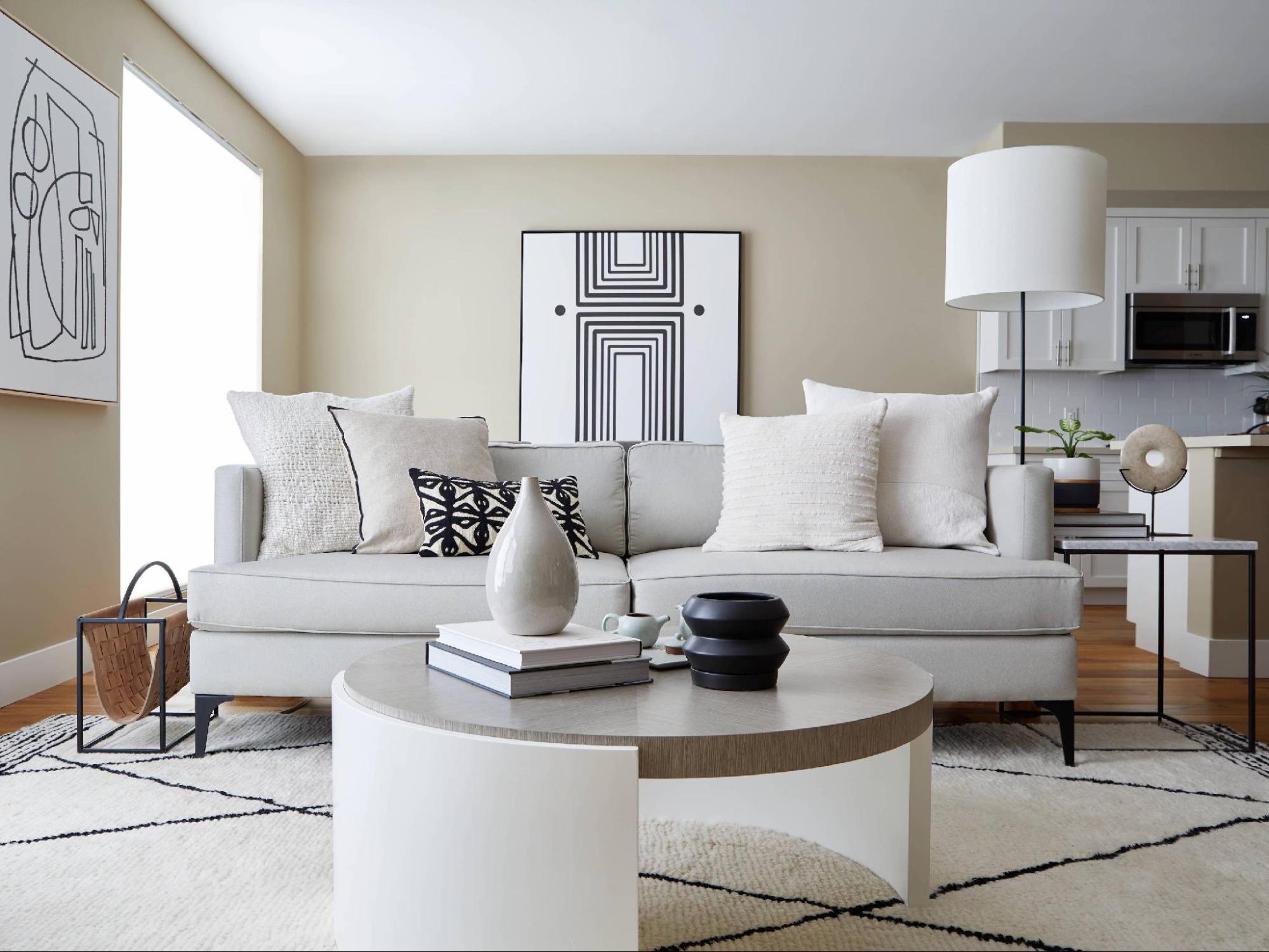
The small living room ideas that actually work have less to do with illusion than with edit and scale. A compact room does not need to trick the eye into thinking it is larger. It needs every piece in it to be the right size, doing real work, with enough open floor to move through. Most cramped rooms aren’t too small. They are overfilled, and filled with the wrong-sized things. Get the scale and the edit right, and a small living room can feel as calm and composed as any large one, without a single mirror or a gallon of white paint.
Table of Content |
Less than you’d think. A large mirror across from a window helps, and a lighter wall reflects more light, but those are finishing touches, not the fix. A small living room feels right when the furniture is scaled to the room, edited down to a few good pieces, and arranged so you can still move through it easily.
The internet is full of small-room tricks, and most of them are fine as far as they go. They just aren’t the lever. You can paint a cramped room white, hang a mirror, and still trip over the coffee table on your way to the sofa. What actually changes a small living room is less visible and more demanding. It is the edit, and a small room rewards subtraction in a way a large one never demands.
Designing a small room is closer to editing a paragraph than decorating a hall. Every piece has to earn the space it takes, or it gets cut. Get that right and the room feels calm and open. Get it wrong and no mirror will save it.
In a small room, scale is unforgiving. The same oversized sofa that reads as generous in a large living room swallows a small one whole, and a coffee table a few inches too big stops the whole room from breathing. Scale is how a piece relates to the room; proportion is how the pieces relate to each other. Both matter everywhere, but a small room leaves no margin for getting them wrong. In all my years of designing rooms like these, I have never once had a client wish their sofa were bigger. The regret always runs the other way.
The instinct most people have is the opposite mistake. They buy small, apartment-sized everything. Miniature furniture makes a room feel like a dollhouse rather than a home, and it rarely seats anyone comfortably. The aim is furniture that is proportionate, sized to the actual room, with enough of it to live on and enough open floor to cross.
A rough guide that helps is to let furniture fill around sixty percent of the room and leave the other forty open. That open forty is not wasted. It is the part of the room you actually move through, and it is what keeps a small space from feeling packed.
Furnishing a small living room well starts with the pieces you decide not to buy. It has less to do with clever, space-saving gadgets than with choosing a few pieces and choosing them right. A small living room rarely needs more than a sofa, a pair of chairs, a coffee table, and one good light.
The work comes down to a few choices:
If there is a single lever, it is circulation. A small living room feels bigger when you can move through it without weaving around the furniture. Light helps and restraint helps, but the felt size of a room tracks how easily a body crosses it, more than anything the eye is told.
Most of the real gains come from trading heavy choices for lighter ones. A heavy block coffee table stops sightlines where an open frame lets them pass. A sofa skirted to the floor reads heavier than one raised on legs, where the strip of visible floor underneath makes the whole room feel larger. One oversized sectional locks the room in place, while a well-scaled sofa and two swivel chairs move with it. And a scatter of small mirrors clutters a wall where a single large one, set across from a window, quietly opens the view.
Tall, narrow elements like drapery hung close to the ceiling make the walls read higher than they are, which draws the eye up and off the floor. Light and color do their part on top of this. A wall that bounces daylight, a palette that doesn’t chop the room into sections, all of it helps. But it helps a room that is already scaled and edited well. In a room that isn’t, it is lipstick.
A small room punishes a careless choice and rewards a precise one. We design them with more attention than a large room, not less, because there is nowhere for a mistake to hide.
Kanika Bakshi Khurana
There is a quiet snobbery in design that treats a small room as a lesser problem, something to solve with hacks. We see it the other way around. A small living room punishes a careless choice that a large one could absorb, which means it asks for more precision, not less. A compact condo living room in San Jose, designed with real attention to scale and flow, will outperform a sprawling room filled without a real plan.
Kanika Design, an interior design firm based in the San Francisco Bay Area, brings the same full-service process to a compact room as to a whole house, the same care with scale, sourcing, and how a family actually lives. If your small living room feels cramped and you are tired of tricks that don’t hold, start a conversation with our studio. The fix usually begins with what to take out. You can see the same attention to scale in getting the proportions right, and to materials in building a room in layers, the way an interior designer in San Jose ought to work.
Read Also – 20 Living Room Design Ideas for a Cozy Gathering Space
A small living room usually wants a sofa shorter than the 84-to-96-inch range a standard room takes. Size it to the wall it sits against, leave room to pass at either end, and pick one raised on legs so it reads lighter than a skirted piece. The right length is the one that leaves the room a path, not the largest that fits.
Start by protecting the path through the room, then set the largest piece, usually the sofa, against the longest wall. Keep the rest minimal and pulled in slightly so nothing blocks the route. Float pieces only when there is genuine room to walk around them. Easy movement is what makes a small arrangement work.
A little. One large mirror across from a window extends the view and bounces daylight, which can help. Scattering several small mirrors does the opposite and reads as clutter. A mirror is a finishing touch, not a fix. It works on a room that is already well scaled, not in place of scaling it.
Lighter colors reflect more light and can make a small room feel more open, but color is not the main lever. A cohesive palette that doesn’t chop the room into parts matters more than how pale it is. A well-proportioned room in a deep color will feel larger than a cramped one painted white.
Cozy and cramped are different problems. Cramped comes from too much furniture or the wrong scale. Cozy comes from soft materials and warm light. Edit the room down to the right pieces first, then layer in warmth with texture and lamplight. A small room with space to move can be both open and snug.
RECENT COMMENTS