

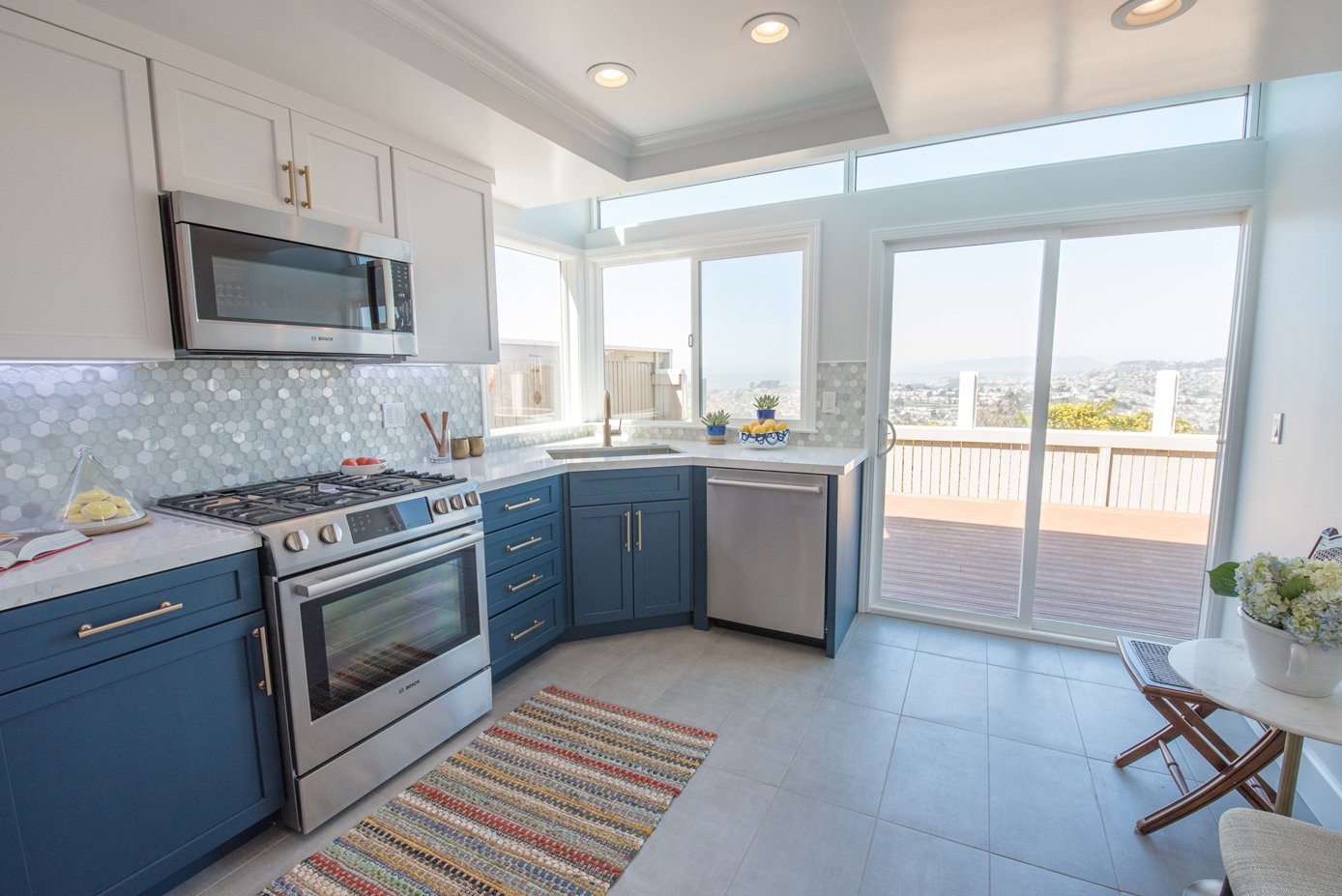
Rare stone — marble, quartzite, onyx — is the one kitchen material that cannot be reordered. Each slab is cut once from a single quarry block; the veining, depth, and movement of that piece will never be replicated. Kitchen marble design is not just a style decision. It is a sourcing decision, and it has to be made early.
Table of Content |
In Bay Area luxury kitchens, where the countertop, backsplash, and floor are often specified from the same stone family, the slab you choose sets the logic for every other surface in the room. Getting it right means finding the stone before the design is locked — not after.
Most homeowners arrive at the stone yard late. The cabinets are specified, the layout is set, and they are looking for a countertop that fits what they’ve already decided. On a standard kitchen remodel, this works. On a luxury project where the stone is the centerpiece, it produces the wrong result — not because the stone is wrong, but because the stone didn’t get to shape anything.
Rare stones should enter the design process in Phase 1. Here is why.
A marble slab quarried in Carrara, Italy, or a quartzite block from Brazil does not arrive in two weeks. From order to delivery, rare stone typically runs 8 to 16 weeks — and that window assumes the specific slab you selected is in the importer’s warehouse, not still in transit from the quarry.
For a Bay Area kitchen remodel, the order matters:
Reverse the order — cabinets first, stone second — and you are either cutting around a slab that doesn’t quite fit or waiting 12 weeks while a crew idles. Home remodeling in the Bay Area runs on tight sequencing. One late material order is rarely contained to one phase.
Two slabs cut from the same quarry block will look different when installed. Lighting, scale, and the direction the stone is laid all change how the veining reads. A photo — even a good one — shows you the stone type. It does not show you the slab.
This is why the stone yard visit is non-negotiable on a luxury kitchen project. You are not selecting a material. You are selecting a specific piece — its movement, its tone in natural light, its scale relative to the countertop run you are working with.
Not every yard stocks the full range. Some rare stones — particular grades of Calacatta, dramatic quartzite from specific Brazilian regions, backlit onyx — require going to specialty importers rather than standard suppliers. In the Bay Area, that sometimes means San Francisco’s design district; for rarer material, it occasionally means sourcing internationally. The stone worth building a kitchen around is usually worth the extra step.
Not every stone belongs in every kitchen. The choice between marble, quartzite, granite, and quartz is not a ranked list with a correct answer at the top. It is a match between the stone’s character and how the kitchen is actually used — and how willing the homeowner is to maintain what they’ve chosen.
The table below maps the four main options against the dimensions that matter on a luxury Bay Area kitchen project.
| Stone | Visual character | Durability | Best kitchen use | Maintenance | Source regions |
| Marble | Soft, organic veining; warm or cool depending on variety | Softer and more porous than other natural stones | Statement islands, backsplashes, low-traffic surfaces | Regular sealing; gentle cleaners; etches with acid | Italy (Carrara, Calacatta), Greece, Turkey |
| Quartzite | Dramatic veining; often mistaken for marble, harder in feel | Extremely hard; slightly porous | Countertops, islands, high-use surfaces | Periodic sealing; more forgiving than marble | Brazil, USA, Norway |
| Granite | Bold, mineral-rich patterns; no two slabs alike | Very strong; heat-resistant | All-purpose kitchens, bars, outdoor extensions | Sealing every 1–2 years | Brazil, India, Norway, USA |
| Quartz | Uniform, consistent surface; wide color range | Non-porous; highly stain-resistant | High-traffic counters, backsplashes, wet areas | No sealing needed; easy to clean | Engineered; manufactured globally |
For most Bay Area kitchens where cooking is daily and maintenance matters: quartzite. For statement surfaces in entertaining-focused homes: marble.
One note on quartz: it is the only engineered material in this group. That consistency is its strength — and its limitation. Quartz does not have the geological history of a natural slab. In a luxury Bay Area kitchen where the stone is meant to be the visual anchor of the room, quartz rarely earns that role. It performs well. It does not move the room.
The stone most misapplied in Bay Area luxury kitchens is marble on a primary cooking surface. Marble etches. Lemon juice, wine, and vinegar all leave marks — not damage exactly, but a record of use that some homeowners find beautiful and others find distressing. The designers who specify marble on a main countertop without that conversation have skipped the most important part of the selection process.
Quartzite is the stone we reach for most often when a client wants the look of marble with a surface that holds up to daily cooking. The veining can be just as dramatic. The maintenance is considerably more forgiving. For a kitchen where the stone reads as kitchen marble design but the household actually cooks, quartzite is usually the honest answer.
That said: a marble island in a kitchen used more for entertaining than cooking is a different calculation. The patina marble develops over time — the soft etching, the lived-in quality — is part of what makes it beautiful. The stone earns its place differently than a surface that has to stay pristine.
Kanika Design approaches every kitchen stone decision as both a design and a lifestyle question. The right material is the one that matches both.
The most common mistake in a luxury kitchen is treating the countertop, backsplash, and floor as three separate decisions. They are one decision made in three stages — and the order in which they are made determines whether the room coheres or competes with itself.
The stone on the counter sets the palette. The backsplash either amplifies it or interrupts it. The floor either grounds the composition or fights it. Specify them independently, at different points in the project, and you will spend considerable money producing a kitchen that feels almost right.
A countertop slab is not selected by stone type. It is selected by the specific piece — its veining direction, its tonal range, and how its movement reads across the full counter run. These are things you cannot assess from a sample. They require standing in front of the full slab, in natural light, with the countertop dimensions in hand.
Here is what a designer reads at the stone yard that a homeowner typically doesn’t catch on a first visit:
A slab with strong diagonal movement will read very differently depending on which way it is oriented. Horizontal veining on a long island creates calm. The same stone rotated 90 degrees creates tension. Neither is wrong — but the choice has to be made at the yard, not on site.
On a counter run longer than the slab, seams are unavoidable. The question is whether they land at a natural break in the veining or cut across the stone’s movement. A poorly placed seam on a dramatic marble countertop is visible from across the room.
Some stones shift in tone from one end to the other. On a small surface, this adds character. On a long kitchen counter, it can read as two different materials on the same plane.
Quartzite and marble often show undertones — green, pink, gold — that only appear under warm or cool light. Bring a photo of your cabinet finish and view the slab under lighting close to what the kitchen will have.
Marble countertop designs earn their place in a luxury kitchen when the slab is chosen this way — specific piece, specific orientation, specific seam placement. Chosen from a sample board, the same stone can look ordinary.
A full-height stone backsplash — floor to ceiling, uninterrupted — is the move that most changes how a luxury kitchen reads. Not because more stone is always better, but because a full-height run treats the wall as a single surface rather than a functional afterthought behind the range.
The design cases for full-height vs. standard height are straightforward:
It works best when the cabinetry is restrained — handleless, flat-front, neutral — so the stone has room to be the statement.
It is the right call when the countertop stone is already dramatic and a full wall would overwhelm the room.
Bookmatching — cutting two slabs from the same block and opening them like a book so the veining mirrors across the join — is the strongest design move available with natural stone. On a kitchen wall marble feature, a bookmatched backsplash behind the range turns a functional surface into something closer to a piece of art. The veining becomes symmetrical, deliberate, and impossible to replicate with tile.
The most overused backsplash treatment in Bay Area luxury kitchens is large-format marble tile laid in a simple stack bond with wide grout lines. The individual tiles are often beautiful. The result reads as a budget approximation of full slab stone — which is the opposite of the effect intended. If the budget allows slab stone on the counter, it usually allows slab stone on the backsplash. The grout lines are what give it away.
Read Also – Timeless Kitchen Design: Where Classic Meets Modern Elegance
Stone on the floor reads differently than stone on a wall or counter. Scale changes. Pattern repeat matters. And the finish — honed versus polished — changes not just the look but how the surface feels underfoot and how it wears over time.
Three decisions determine whether a marble kitchen floor works or doesn’t:
Honed marble is the honest choice for a kitchen floor. Polished marble shows every footprint and water mark in a way that polished marble on a countertop does not — feet and spills are harder on a surface than hands and prep work. A matte or leathered finish on a darker stone grounds the room without competing with polished surfaces above it.
Large-format slabs — 24×48 or larger — minimize grout lines and let the stone’s movement read across the room continuously. Smaller tiles introduce pattern repeat, which works in the right kitchen and reads as busy in the wrong one. Decide the floor format in relation to ceiling height and room size, not independently.
Matching stone families creates continuity — the room reads as a single composition. Contrasting stone creates definition — it separates the kitchen zone from adjoining spaces. Both are valid. Decide deliberately, with both materials in the room at the same time before anything is ordered.
Sourcing rare stone for a luxury kitchen is not a showroom visit. It is a process — and the process starts before the design is finalized, not after it.
For Kanika Design projects in Atherton, Palo Alto, and across the Bay Area, stone sourcing runs in three stages:
Each stage has different lead times and different access requirements. Here is how the process works in practice.
The Bay Area has strong stone resources. San Francisco’s design district carries a wide range of marble, quartzite, and granite slabs. For most projects, the right stone is findable within a day of yard visits — provided the designer knows what to look for and what questions to ask the importer about the slab’s origin, grade, and available quantity.
Quantity matters more than most homeowners realize. A kitchen that uses the same stone across the countertop, backsplash, and floor needs enough material from the same quarry run to read consistently. Two slabs from different production batches — even the same stone type, same supplier — can vary enough in tone to read as different materials under the same light. Confirming the available lot size before committing to a stone is part of the sourcing work, not an afterthought.
Some stones are not consistently stocked in Bay Area yards. Particular grades of Calacatta marble — the white Italian marble with bold gold or grey veining that anchors some of the most considered luxury kitchens — are available only through specialty importers, and the best slabs move quickly. The same applies to high-drama Brazilian quartzite: Verde Labrador, Fantasy Brown, and similar materials with strong movement often require sourcing from importers who bring containers directly from quarries.
Globally sourced marble countertops are not a premium add-on for the largest budgets only. They are often the only path to a specific material — and the lead time difference between locally stocked and internationally sourced stone is exactly why the sourcing conversation has to happen in Phase 1.
Kanika’s background informs this directly. Having visited over 64 countries — including stone-producing regions where material is seen in its quarried context, not in a showroom — she reads a slab differently than someone who has only encountered stone in a yard. In Naples, the use of granite in public and institutional settings — door trims, floors, architectural details — shows how the same material treated as a countertop option in a Bay Area kitchen has, in other contexts, been considered a permanent architectural surface for centuries. That perspective changes how a slab is evaluated: not just for how it looks today, but for how it will read in 20 years.
Full home remodeling in Atherton operates at a finish level where the stone is rarely an afterthought. The kitchens we work on in Atherton — and in Palo Alto, Saratoga, and Los Altos Hills — tend to involve stone across multiple surfaces, often from the same material family. That scope requires earlier sourcing decisions, larger lot confirmations, and more careful seam and layout planning than a single-surface countertop project.
It also requires a designer who treats the stone yard as a design tool, not a supply stop. The slab selection visit is where the kitchen’s visual logic is confirmed — or, occasionally, where the original design direction changes because a better stone presented itself. That flexibility is only available if the sourcing happens before the design is closed.
On projects like these — in Atherton, Palo Alto, and across the Bay Area — that oversight is not an optional service. It is how the kitchen gets built the way it was designed.
Rare stone is the one kitchen material that sets the terms for everything around it. The cabinet finish, the hardware, the floor — all of them respond to the slab. Get the stone right and the rest of the room follows. Choose it late, from a sample board, under time pressure, and the room will show it.
We work with homeowners in Atherton, Palo Alto, Los Altos Hills, and across the Bay Area on kitchens where the stone is the starting point — not the last decision. If you are planning a kitchen remodel and want a designer who treats the stone yard as part of the design process, Kanika Design would be glad to start that conversation.
The best marble design for a kitchen depends on how the kitchen is used. For a high-traffic cooking kitchen, quartzite with marble-like veining outperforms true marble on durability while delivering the same visual character. For a kitchen used more for entertaining than daily cooking, a Calacatta or Statuario marble island — honed, not polished — is hard to match for presence. The best marble design is the one chosen for the specific slab, not the stone category.
Full slab stone — marble or quartzite — is the strongest choice for a luxury kitchen backsplash. It eliminates grout lines, allows bookmatching, and treats the wall as a single surface rather than a tiled field. Large-format marble tile backsplashes often approximate the look of slab stone without achieving it; if the budget allows slab stone on the counter, it almost always allows slab stone on the backsplash too.
Choose marble if the kitchen is used lightly and you are comfortable with a surface that develops patina over time — etching and softening with use. Choose quartzite if the kitchen sees daily cooking, acidic ingredients, or heavy prep work. Quartzite offers the veining drama of marble with significantly better resistance to etching and staining. Quartzite countertops are the more practical answer for most Bay Area households; marble is the more expressive one.
Rare stone sourcing typically runs 8 to 16 weeks from order to delivery for internationally sourced material — longer if the specific grade requires a specialty importer or a container shipment from the quarry. Locally stocked slabs can move faster, but the best material at any given yard sells quickly. For a Bay Area kitchen remodel, the stone order should be placed in Phase 1 of the project, before cabinet drawings are finalized, to avoid delays downstream.
Yes — in two specific ways. First, a luxury interior designer working in Atherton will visit the stone yard with the full kitchen layout in hand, selecting the specific slab rather than approving a stone type. Second, they will confirm lot availability across all surfaces — counter, backsplash, and floor — before committing, to ensure the material reads consistently across the room. A Bay Area interior designer managing the full sourcing process also has relationships with specialty importers that give access to rarer grades not carried in standard yards. The result is a kitchen built around a specific piece of stone, not a category of material.
RECENT COMMENTS